
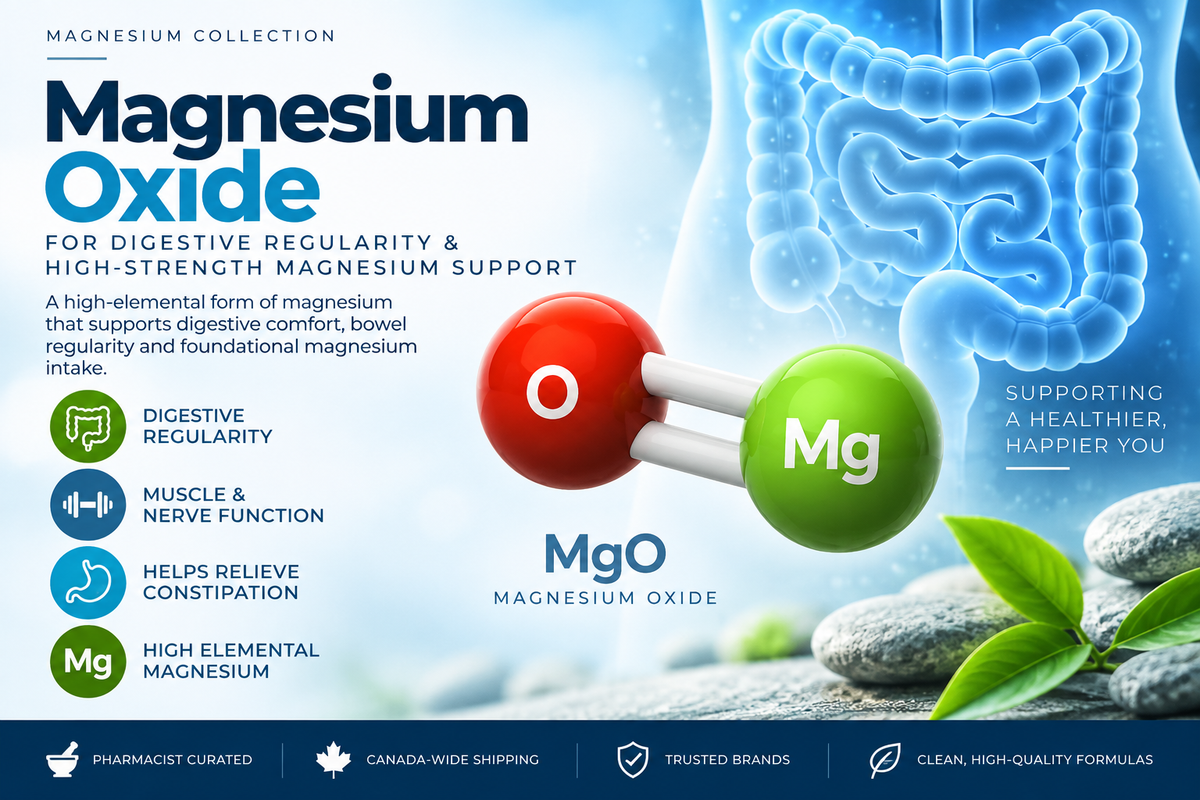
Magnesium Oxide – Digestive Regularity & High-Strength Magnesium Support
Support occasional constipation, digestive regularity, and essential magnesium intake with magnesium oxide—a widely used, economical form that provides a high proportion of elemental magnesium by weight.
────────────────────────────────────
About Magnesium Oxide
Magnesium oxide (MgO) is a mineral compound made from magnesium and oxygen. It is one of the most widely used forms of magnesium in supplements, antacids, and certain laxative products.
A key characteristic of magnesium oxide is its high elemental magnesium content by weight. However, a high elemental percentage does not necessarily mean more magnesium will be absorbed: magnesium oxide generally has lower fractional absorption than several more soluble magnesium salts.
The Magnesium Oxide collection at Coal Harbour Pharmacy includes capsules, tablets, powders, and combination formulas for adults seeking magnesium supplementation, digestive regularity, or occasional constipation support, depending on the individual product.
Key Benefits
• Provides a high proportion of elemental magnesium by weight
• Supports normal muscle and nerve function
• Contributes to normal energy metabolism
• Helps maintain electrolyte balance
• Supports normal bone and cardiovascular function
• Can promote bowel regularity through an osmotic laxative effect
• Used in certain products for occasional constipation
• Used in some antacid formulations
• Offers an economical and widely available magnesium option
Who It’s Ideal For
Magnesium oxide may be appropriate for:
• Adults looking for a straightforward magnesium supplement
• People seeking bowel-regularity support
• Individuals looking for short-term relief of occasional constipation when using an appropriately labelled product
• Adults who prefer a higher elemental-magnesium concentration per amount of compound
• People comparing economical magnesium options
• Individuals who tolerate its gastrointestinal effects well
• Adults advised by a healthcare professional to supplement magnesium
People primarily seeking magnesium without bowel stimulation may prefer to compare oxide with forms such as magnesium glycinate.
What Is Magnesium Oxide?
Magnesium oxide is an inorganic magnesium salt with the chemical formula MgO.
Because magnesium represents a relatively large proportion of the compound’s molecular weight, magnesium oxide can provide a substantial amount of elemental magnesium from a relatively small amount of compound.
This characteristic makes it common in:
• Standalone magnesium supplements
• Multivitamin and mineral formulas
• Bone-health supplements
• Antacid preparations
• Laxative products
Its nutritional usefulness should be evaluated by considering both elemental magnesium content and absorption, rather than either factor alone.
Magnesium Oxide & Elemental Magnesium
One of magnesium oxide’s main practical advantages is its relatively high elemental-magnesium percentage.
This can make labels appear particularly potent compared with magnesium glycinate, citrate, malate, or L-threonate.
However, the amount listed on a label should not be interpreted as a direct measure of how much magnesium ultimately enters the bloodstream.
Magnesium absorption depends on factors such as:
• Solubility
• Supplemental amount
• Gastrointestinal conditions
• Individual magnesium status
• Food intake
• Formulation
For this reason, high elemental magnesium does not automatically mean superior magnesium delivery.
Is Magnesium Oxide Well Absorbed?
Magnesium oxide generally has lower fractional absorption than several more soluble magnesium salts, including magnesium citrate in comparative studies.
That does not mean magnesium oxide provides no absorbable magnesium.
Instead, it means shoppers should avoid assuming that a larger elemental-magnesium number automatically makes oxide more effective than other forms.
The most appropriate magnesium supplement depends on the reason for supplementation, dose, tolerance, formulation, and individual needs.
Magnesium Oxide for Digestive Regularity
Magnesium oxide can have an osmotic effect within the gastrointestinal tract.
Poorly absorbed magnesium remaining in the intestine can help retain water, which can:
• Increase stool water content
• Soften stool
• Promote bowel movements
• Support digestive regularity
This is one reason magnesium oxide is commonly used in products intended for constipation and bowel support.
The effect varies according to the amount taken and the individual.
Magnesium Oxide for Occasional Constipation
Appropriately formulated magnesium products can be useful for short-term relief of occasional constipation.
However, a daily magnesium supplement and a product specifically labelled as a laxative may have different doses and directions.
Persistent constipation can have many causes, including:
• Inadequate fibre intake
• Low fluid intake
• Physical inactivity
• Medication effects
• Irritable bowel syndrome
• Thyroid disorders
• Pelvic-floor dysfunction
• Other gastrointestinal conditions
Constipation accompanied by significant abdominal pain, vomiting, blood in the stool, unexplained weight loss, fever, or inability to pass stool or gas warrants prompt medical assessment.
Magnesium Oxide as an Antacid
Magnesium oxide may also be included in products intended to neutralize stomach acid.
Its alkaline properties can contribute to antacid activity.
This does not mean ordinary magnesium oxide supplements should automatically be used to treat persistent heartburn, reflux, or abdominal symptoms.
Frequent or worsening heartburn deserves appropriate assessment, particularly when accompanied by difficulty swallowing, gastrointestinal bleeding, unexplained weight loss, or chest pain.
Magnesium Oxide for Muscle Function
Magnesium is essential for normal muscle contraction and relaxation.
Adequate magnesium also contributes to:
• Neuromuscular signalling
• Electrolyte balance
• Protein synthesis
• Normal energy metabolism
Magnesium deficiency can cause muscular symptoms, but common cramps and tightness are not always due to magnesium deficiency.
Magnesium oxide should therefore not be expected to reliably eliminate cramps, spasms, or muscle pain in everyone.
Magnesium Oxide & Nerve Function
Magnesium contributes to normal nerve transmission and neuromuscular communication.
Magnesium oxide can provide magnesium for these normal physiological functions.
It should not, however, be presented as a treatment for neuropathy, anxiety disorders, neurological disease, or nerve damage.
Magnesium Oxide & Energy Metabolism
Magnesium is required for numerous ATP-dependent reactions throughout the body.
Adequate magnesium therefore contributes to normal cellular energy metabolism.
Magnesium oxide is not a stimulant and should not be expected to produce an immediate increase in energy.
If significant or persistent fatigue is present, other nutritional, medical, medication-related, and lifestyle causes should also be considered.
Magnesium Oxide vs Magnesium Citrate
Magnesium Oxide
Commonly selected for:
• High elemental-magnesium concentration
• Economical supplementation
• Bowel support
• Certain laxative and antacid products
Magnesium Citrate
Commonly selected for:
• General magnesium supplementation
• Better solubility
• Digestive regularity
• Occasional constipation support
Both can loosen stools, but magnesium citrate generally has better fractional absorption than magnesium oxide.
Magnesium Oxide vs Magnesium Glycinate
Magnesium Oxide
Often chosen for:
• Higher elemental-magnesium concentration
• Economical supplementation
• Digestive and bowel effects
Magnesium Glycinate / Bisglycinate
Often chosen for:
• General daily magnesium supplementation
• Relaxation-focused routines
• People who want less laxative activity
• Gastrointestinal tolerance
People whose main priority is avoiding bowel stimulation may find glycinate more practical, although individual responses vary.
Magnesium Oxide vs Magnesium Malate
Magnesium malate is commonly marketed toward muscle and energy-focused supplementation, while magnesium oxide is more frequently chosen for economical magnesium intake and digestive applications.
Magnesium malate is generally more soluble, but there is no need to assume every person requires a specialized magnesium form.
The best choice depends on the intended use and individual tolerance.
When to Consider Another Magnesium Form
Magnesium oxide may not be the most practical choice when bowel stimulation is undesirable.
Other commonly considered forms include:
Magnesium Glycinate / Bisglycinate – Popular for general magnesium supplementation and relaxation-focused routines with less laxative activity.
Magnesium Citrate – Useful when magnesium supplementation and bowel regularity are both priorities.
Magnesium Malate – Often selected for muscle and energy-metabolism-focused routines.
Magnesium L-Threonate – A specialized form primarily marketed and researched for cognitive applications.
The names of these compounds matter less than choosing an appropriate elemental magnesium amount, formulation, and intended use.
Magnesium Oxide Formats
Capsules
Convenient for consistent, pre-measured supplementation.
Tablets
Common, economical, and widely available.
Powders
May offer adjustable serving sizes, depending on the product.
Combination Formulas
Magnesium oxide is frequently combined with:
• Other magnesium forms
• Calcium
• Vitamin D
• Zinc
• Other vitamins and minerals
When using a combination product, consider the total elemental magnesium from all sources.
Magnesium Oxide Safety
Magnesium oxide is generally well tolerated when used appropriately, but its gastrointestinal effects can include:
• Loose stools
• Diarrhea
• Abdominal cramping
• Nausea
Excessive laxative effects can contribute to dehydration and electrolyte disturbances.
People with significantly impaired kidney function require particular caution because reduced kidney clearance can allow magnesium to accumulate in the bloodstream.
Very high magnesium levels can become medically serious.
Magnesium & Medication Interactions
Magnesium can interfere with the gastrointestinal absorption of certain medications.
Important examples include some:
• Tetracycline antibiotics
• Fluoroquinolone antibiotics
• Bisphosphonates
• Thyroid medications such as levothyroxine
Appropriate separation varies according to the medication.
A pharmacist can help determine the correct timing.
FAQs
What is magnesium oxide?
Magnesium oxide is a compound of magnesium and oxygen used in nutritional supplements as well as certain laxative and antacid products.
Is magnesium oxide high in elemental magnesium?
Yes. Magnesium oxide contains a relatively high proportion of elemental magnesium by weight, although its fractional absorption is lower than that of several more soluble magnesium forms.
Is magnesium oxide good for constipation?
Magnesium oxide can have an osmotic laxative effect and is used in some products for constipation. Use a product appropriately labelled and dosed for that purpose.
How does magnesium oxide help bowel movements?
Magnesium remaining within the intestine can retain water, helping soften stool and promote bowel movements.
Is magnesium oxide well absorbed?
It provides absorbable magnesium, but its fractional absorption is generally lower than that of several more soluble forms, such as magnesium citrate.
Does magnesium oxide help muscle cramps?
Magnesium is necessary for normal muscle function, and deficiency can cause muscular symptoms. Supplementation does not consistently relieve ordinary muscle cramps when magnesium status is adequate.
Is magnesium oxide an antacid?
Magnesium oxide has acid-neutralizing properties and is used in certain antacid products. Follow the intended use and directions of the specific product.
Which is better: magnesium oxide or citrate?
They have different practical characteristics. Oxide provides a high proportion of elemental magnesium and can support bowel function, while citrate is generally more soluble and also commonly used for digestive regularity.
Which is better: magnesium oxide or glycinate?
Glycinate is commonly selected when general magnesium supplementation and lower laxative activity are priorities. Oxide is often chosen for its high elemental-magnesium concentration, affordability, and digestive effects.
Can magnesium oxide be taken every day?
Some magnesium oxide supplements are formulated for daily nutritional use. Products intended as laxatives or antacids may have different directions. Total magnesium intake, kidney function, medications, and individual tolerance should be considered.
Why Shop Magnesium Oxide at Coal Harbour Pharmacy?
• Pharmacist-curated magnesium oxide supplements
• Capsules, tablets, powders, and combination formulas
• Clearly labelled elemental magnesium strengths
• Options for magnesium and digestive-support routines
• Trusted Canadian and professional wellness brands
• Fast Canada-wide shipping
Related Collections
• Magnesium
• Magnesium Citrate
• Digestive Health
• Minerals
────────────────────────────────────
Shop Magnesium Oxide →
Sort by
4 products




Free Delivery
Satisfied or refunded
Top-notch support
Secure payments
Encrypted checkout processing
Offers exclude prescriptions and in-store purchases.
Subscribe & Get a First-Order Reward
Plus, earning reward points on eligible online purchases and enjoy future store credit.
We respect your inbox at Coal Harbour Pharmacy - Expect thoughtfully curated health and wellness updates, timely reminders, and exclusive online savings.