
Article: Black Cumin vs Black Seed Oil: What's the Difference & Which Should You Choose?
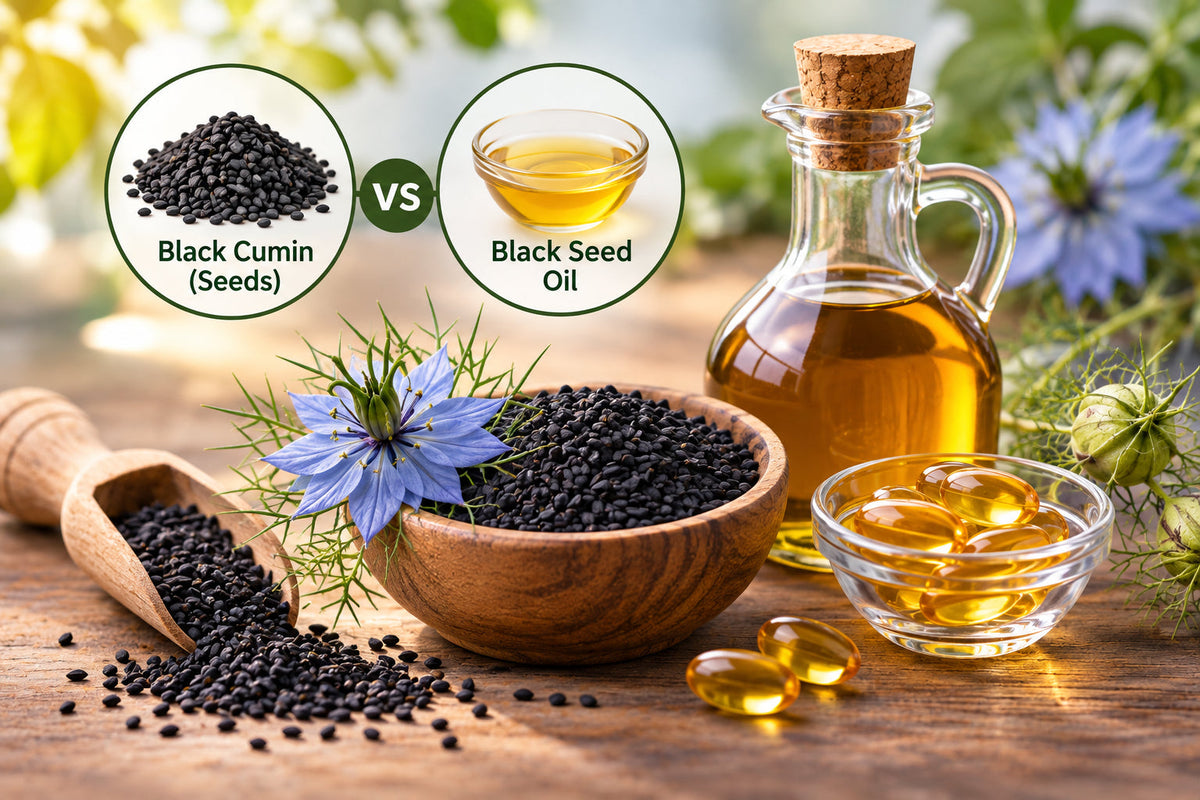
Black Cumin vs Black Seed Oil: What's the Difference & Which Should You Choose?
Black Cumin Seeds, Nigella sativa Oil, Softgels & Extracts Explained
Black cumin or black seed oil—which one should you choose?
If you've been researching natural supplements for immune wellness, antioxidant support, or metabolic health, you've probably encountered both names. Some products are labelled black cumin, others black seed oil, and many mention Nigella sativa or thymoquinone.
The confusing part? Black cumin and black seed oil often come from exactly the same plant.
The real differences usually involve the product's form, extraction method, concentration, ingredients, and intended use.
Whether you're comparing liquid black seed oil, convenient softgels, or concentrated botanical extracts, understanding these distinctions can help you choose a supplement that fits your preferences and wellness goals.
In this guide, we'll explore what makes each form different, what scientific research actually suggests, and how to compare black cumin supplements available in Canada.
Explore Black Cumin & Black Seed Oil Supplements at Coal Harbour Pharmacy
Quick Answer: Is Black Cumin the Same as Black Seed Oil?
Yes, in many supplement products—but the terms describe different things.
Black cumin commonly refers to the seeds of Nigella sativa, a flowering plant traditionally used in Middle Eastern, South Asian, and Mediterranean cultures.
Black seed oil is the oil extracted from those seeds.
However, the term black cumin is sometimes used for other plants, so checking the botanical name is essential.
| Feature | Black Cumin Seeds | Black Seed Oil |
|---|---|---|
| Botanical source | Usually Nigella sativa | Nigella sativa |
| Form | Whole or ground seeds | Extracted seed oil |
| Common uses | Culinary and traditional herbal use | Culinary or supplemental use, depending on product |
| Main components | Fibre, seed proteins, oils, and plant compounds | Fatty acids and oil-soluble compounds |
| Thymoquinone | Naturally present | Naturally present; amount varies |
| Supplement formats | Whole seeds, powders, capsules | Liquid oils and softgels |
| Convenience | Requires measuring or preparation | Liquid dosing or premeasured softgels |
| Best choice | Culinary use and whole-seed preference | Customers seeking an oil-based supplement |
Bottom line: Neither form is automatically superior. The better choice depends on the exact formulation, quality, intended use, and personal preference.
What Is Black Cumin (Nigella sativa)?
Black cumin comes from Nigella sativa, an annual flowering plant belonging to the Ranunculaceae family.
Its small, dark seeds have been used for centuries in traditional food preparations and herbal practices.
The seeds are also known as:
-
Black seed
-
Kalonji
-
Nigella
-
Black caraway
-
Habbat al-barakah
These names are sometimes used interchangeably, although regional terminology can be inconsistent.
Is Black Cumin the Same as Regular Cumin?
No.
Despite their similar names, black cumin and ordinary cumin are botanically different.
Black cumin: Nigella sativa
Regular cumin: Cuminum cyminum
Regular cumin belongs to the parsley family and is commonly used as a culinary spice.
Nigella sativa belongs to the buttercup family and has a different chemical composition.
Why Does the Botanical Name Matter?
Because common names can overlap between unrelated plants.
When purchasing black cumin supplements, look for:
Nigella sativa
This is the botanical name associated with the black seed oil products discussed in this guide.
What Is Black Seed Oil?
Black seed oil is produced by extracting oil from Nigella sativa seeds.
It contains naturally occurring fatty acids and other compounds found in the seed.
Two notable fatty acids are:
Linoleic Acid
An essential omega-6 fatty acid involved in normal physiological functions.
Oleic Acid
A monounsaturated fatty acid also found in foods such as olive oil.
Black seed oil also contains smaller amounts of other plant compounds, including thymoquinone.
What Does Cold-Pressed Black Seed Oil Mean?
Cold pressing is a mechanical extraction process that generally avoids the high temperatures associated with some other oil-processing methods.
It is commonly used for botanical oils.
However, cold-pressed does not automatically mean more effective.
The final product's quality also depends on:
-
Seed quality
-
Processing conditions
-
Storage
-
Oxidation control
-
Contaminant testing
-
Product formulation
-
Packaging
A reputable manufacturer should provide clear information about its ingredients and quality standards.
Black Cumin vs Black Seed Oil: The Key Differences
Although both forms can come from the same plant, their composition and practical uses differ.
1. Whole Seeds Contain More Than Oil
Whole black cumin seeds contain fibre, proteins, and other components that are not present in the same proportions in extracted oil.
This makes whole seeds more suitable for culinary applications.
2. Black Seed Oil Concentrates the Oil Fraction
Extracting oil separates much of the seed's fat-containing fraction from its other components.
The resulting product is convenient for customers seeking an oil-based supplement.
However, this does not mean that every black seed oil contains the same concentration of thymoquinone.
3. Softgels Offer Convenient Portions
Softgels contain measured amounts of oil inside a capsule shell.
They may be preferable for people who dislike the taste of liquid black seed oil.
4. Extracts Can Have Different Concentrations
Some botanical extracts are standardized to specific compounds.
A standardized extract is not necessarily equivalent to an ordinary cold-pressed oil.
Always compare the actual ingredients and concentration rather than assuming that a higher number means a better product.
5. Different Forms May Have Different Directions
A liquid oil, softgel, and concentrated extract should not automatically be taken in equivalent quantities.
Follow the directions for the specific product.
What Is Thymoquinone, and Why Does It Matter?
Thymoquinone is one of the most extensively studied compounds associated with Nigella sativa.
It has attracted scientific interest because laboratory and animal research has identified several biological activities.
These include:
-
Antioxidant activity
-
Effects on inflammatory signalling
-
Interactions with cellular pathways
-
Potential metabolic effects
However, laboratory findings do not automatically translate into proven benefits in humans.
Does More Thymoquinone Mean Better Results?
Not necessarily.
Thymoquinone concentration can vary between products, and there is no universally established optimal concentration for general wellness supplementation.
A higher concentration is not automatically safer or more effective.
Should You Choose a Standardized Product?
Standardization may help customers compare formulations, but it should be evaluated alongside the product's intended use, safety information, and quality testing.
For Canadian natural health products, the authorized label and Natural Product Number (NPN) are especially relevant.
Black Seed Oil Benefits: What Does the Research Actually Say?
Black seed oil is frequently promoted for immune health, inflammation, cholesterol, blood sugar, and general wellness.
But not every popular claim has the same level of scientific support.
1. Antioxidant Activity
Nigella sativa contains compounds that have demonstrated antioxidant activity in laboratory research.
Antioxidants interact with processes involving oxidative stress.
Some human studies have also examined changes in oxidative stress markers following supplementation.
What this means: Antioxidant activity is a legitimate research area, but it does not establish that black seed oil prevents chronic disease or provides a specific clinical benefit for every user.
2. Inflammatory Response
Thymoquinone and other Nigella sativa constituents have been studied for their effects on inflammatory pathways.
Human studies have investigated inflammatory biomarkers, including C-reactive protein.
Some findings are encouraging, but results vary across populations, doses, and formulations.
What this means: Black seed oil is being investigated for inflammatory health, but it should not replace prescribed anti-inflammatory treatment.
3. Blood Sugar & Metabolic Health
Several clinical trials have examined Nigella sativa supplementation in people with metabolic health concerns.
A 2024 systematic review and meta-analysis reported improvements in certain blood glucose measurements, including fasting blood glucose and HbA1c.
However, the studies differed substantially in their designs and results.
What this means: Black seed supplementation may influence some metabolic markers, but it is not an established substitute for diabetes medication or professional medical care.
4. Cholesterol & Cardiovascular Health
Researchers have also studied black cumin supplementation for its potential effects on cholesterol and other cardiovascular risk factors.
A 2025 systematic review incorporating 82 studies reported improvements in several metabolic and cardiovascular measurements.
Nevertheless, the authors described Nigella sativa as a potential adjunctive approach rather than a replacement for established treatment.
What this means: The research is promising in some areas, but larger, high-quality trials are still needed to determine which products provide meaningful long-term benefits.
5. Immune & Respiratory Wellness
Black cumin has a long history of traditional use for respiratory and general wellness purposes.
Some formulations are marketed in Canada for specific uses related to allergic rhinitis.
However, the evidence for one product or condition should not be generalized to every black cumin supplement.
What this means: Review the exact Canadian product label to understand its authorized indications.
6. Skin & Hair Wellness
Black seed oil is also used in some cosmetic preparations.
Its fatty acid composition makes it relevant to topical skincare formulations.
However, evidence supporting specific hair-growth or skin-treatment claims remains limited.
What this means: A product designed for oral supplementation should not automatically be used topically, and vice versa.
Black Cumin Seeds vs Liquid Oil vs Softgels: Which Form Is Best?
The most useful comparison is often not black cumin versus black seed oil.
It's which form of Nigella sativa best matches your needs.
| Form | Main Advantage | Potential Drawback | Best For |
|---|---|---|---|
| Whole Black Cumin Seeds | Culinary versatility | Less convenient for precise supplement portions | Cooking and traditional food use |
| Ground Black Cumin | Easy to incorporate into foods | Freshness and storage considerations | Culinary preparations |
| Liquid Black Seed Oil | Flexible measured servings | Strong taste and careful measuring required | Customers comfortable with liquid supplements |
| Black Seed Oil Softgels | Convenient, premeasured portions | Capsule ingredients may include gelatin | Customers who prefer capsules |
| Standardized Extracts | Declared concentration of selected compounds | Not directly interchangeable with seed oil | Customers comparing specialized formulations |
Choose Whole Seeds If…
You primarily want black cumin for cooking or traditional food preparations.
Choose Liquid Black Seed Oil If…
You prefer a liquid format and want to measure servings according to the product label.
Choose Softgels If…
You want a convenient supplement format without the taste of the oil.
Choose an Extract If…
You have a specific reason to consider a concentrated formulation and understand its labelled ingredients and directions.
Our recommendation: For most shoppers comparing supplements, start by deciding whether you prefer liquid oil or softgels. Then compare ingredient quality, serving information, and label cautions.
Shop Black Cumin Oil, Softgels & Supplements
Best Black Cumin & Black Seed Oil Supplements to Compare at Coal Harbour Pharmacy
Coal Harbour Pharmacy carries several Nigella sativa products.
The following options are listed in our Black Cumin collection and offer different formats for customers to compare.
1. New Roots HERBAL® Black Cumin Seed Oil — 100 mL or 200 mL
Best for: Customers who prefer organic liquid black seed oil.
New Roots HERBAL® Black Cumin Seed Oil is a cold-pressed liquid oil derived from Nigella sativa seeds.
The CHP product listing identifies:
-
Organic black cumin seed oil
-
Liquid format
-
100 mL and 200 mL options
-
Naturally occurring fatty acids
-
Thymoquinone-related formulation information
-
NPN: 80072262
This product may appeal to shoppers who want a liquid oil rather than capsules.
Its product information also addresses use related to allergic rhinitis, subject to the authorized label.
Why choose it?
The liquid format provides an alternative to softgels and allows customers to select between two bottle sizes.
What to check: Review the physical product label for current directions, ingredient information, and precautions.
Shop New Roots HERBAL® Black Cumin Seed Oil – 100 mL or 200 mL
2. Organika® Black Cumin Seed Oil — 120 Softgels
Best for: Customers who prefer convenient black seed oil softgels.
Organika® offers black cumin seed oil in a 120-softgel format.
This option may be attractive to customers who prefer premeasured capsules instead of liquid oil.
Why choose it?
Softgels simplify supplement handling and avoid the strong taste associated with some liquid black seed oils.
What to check: Review the exact amount of oil per softgel, capsule ingredients, recommended dose, and current product label.
Shop Organika® Black Cumin Seed Oil – 120 Softgels
3. NFH Black Cumin SAP — 60 Softgels
Best for: Customers comparing practitioner-oriented black cumin oil formulations.
Black Cumin SAP by NFH contains organic Nigella sativa seed oil.
The CHP product listing identifies:
-
500 mg black cumin seed oil per softgel
-
60-softgel package
-
Linoleic and oleic acid content
-
NPN: 80047518
-
Additional formulation and safety information
The product is presented as a concentrated black cumin oil supplement.
Why choose it?
It provides a clearly identified amount of black cumin oil per softgel and may appeal to customers comparing detailed formulations.
What to check: Review the current label, including its directions, warnings, and suitability for your health circumstances.
Shop NFH Black Cumin SAP – 60 Softgels
Which Black Seed Oil Supplement Should You Choose?
Here is a practical comparison of three CHP options.
| Product | Format | Size | Main Shopping Advantage |
|---|---|---|---|
| New Roots HERBAL® Black Cumin Seed Oil | Liquid oil | 100 mL or 200 mL | Organic, cold-pressed liquid format |
| Organika® Black Cumin Seed Oil | Softgels | 120 softgels | Convenient capsule format |
| NFH Black Cumin SAP | Softgels | 60 softgels | Clearly identified 500 mg oil per softgel |
Our Buying Recommendation
For liquid oil: Consider New Roots HERBAL®.
For convenient softgels: Compare Organika®.
For a practitioner-oriented formulation: Review NFH Black Cumin SAP.
None of these products is automatically the strongest or most effective simply because of its brand, price, or format.
The appropriate choice depends on the specific formulation and your individual circumstances.
Compare All Black Cumin Supplements at Coal Harbour Pharmacy
How to Choose High-Quality Black Seed Oil in Canada
Before purchasing, review these seven factors.
1. Confirm the Botanical Name
Look for Nigella sativa.
Do not assume that every product called black cumin comes from the same plant.
2. Review the Extraction Method
Cold-pressed oil may be preferable for customers seeking a minimally processed oil.
However, extraction method alone does not establish clinical effectiveness.
3. Check the Ingredient List
Some products contain additional oils, antioxidants, or capsule ingredients.
Review the full formulation, particularly if you have allergies or dietary restrictions.
4. Compare Serving Information
Look at the amount of oil or extract per serving.
Do not compare liquid millilitres and softgel milligrams without considering the product's concentration and directions.
5. Look for Quality Testing
Manufacturer testing may address:
-
Identity and purity
-
Heavy metals
-
Pesticides
-
Microbial contamination
-
Oxidation or stability
Testing claims should be supported by the manufacturer.
6. Check for an NPN
In Canada, licensed natural health products generally carry an eight-digit Natural Product Number.
An NPN indicates that Health Canada has authorized the product for sale under specified conditions.
It does not mean that every possible health claim about black seed oil has been proven.
7. Review Warnings and Interactions
This is especially important if you take prescription medications or manage a chronic health condition.
A quality supplement is one with clear ingredients, appropriate labelling, and a formulation suited to the user—not simply the highest advertised potency.
How to Take Black Cumin or Black Seed Oil
There is no single universal dose for every Nigella sativa supplement.
The appropriate amount depends on:
-
Product format
-
Oil or extract concentration
-
Intended use
-
Individual health circumstances
-
Manufacturer directions
-
Canadian authorized labelling
Should You Take Black Seed Oil With Food?
Some products recommend taking black seed oil with food to reduce gastrointestinal discomfort.
Follow the directions for the specific product.
Can You Take Black Seed Oil Every Day?
Some formulations are designed for repeated use.
However, long-term safety data are limited, and certain Canadian product labels advise consulting a healthcare practitioner before use beyond a specified duration.
Can You Take Black Seed Oil With Other Supplements?
Potential interactions depend on the ingredients involved.
Do not assume that combining several supplements will produce better results.
Can You Combine Black Seed Oil With Other Herbal Products?
Possibly, but the combination should be evaluated individually.
People taking multiple supplements should review the complete ingredient lists with a healthcare professional.
Black Seed Oil Side Effects, Safety & Precautions
Although Nigella sativa has a long history of traditional use, concentrated supplements are not appropriate for everyone.
Possible Side Effects
Reported concerns include:
-
Gastrointestinal discomfort
-
Nausea
-
Allergic reactions
-
Skin irritation from topical use
Individual responses vary.
Pregnancy & Breastfeeding
Avoid medicinal-dose black seed oil supplementation during pregnancy or breastfeeding unless specifically advised by a qualified healthcare professional.
Several CHP-listed products also warn against use while trying to conceive.
Blood Pressure Medications
Some research suggests Nigella sativa may influence blood pressure.
People taking antihypertensive medications should consult a healthcare professional before supplementation.
Diabetes Medications
Because black cumin has been studied for effects on blood glucose, people using glucose-lowering medications should seek advice before taking concentrated supplements.
Other Medication Interactions
The full clinical interaction profile is not established.
Consult a pharmacist if you take prescription medication, especially medication requiring close monitoring.
Surgery
Tell your surgical team about all supplements you take.
Do not rely on a general rule for when to stop a particular herbal product; follow your healthcare team's instructions.
Important: Black seed oil should not replace prescribed treatment for diabetes, high blood pressure, high cholesterol, allergies, or inflammatory conditions.
Black Seed Oil vs Other Popular Herbal Supplements
Black seed oil is often compared with other botanical products.
However, these ingredients are not interchangeable.
| Supplement | Main Compounds | Common Research Interest |
|---|---|---|
| Black Seed Oil | Thymoquinone and fatty acids | Metabolic, antioxidant, and inflammatory pathways |
| Turmeric / Curcumin | Curcuminoids | Inflammatory pathways and joint-related outcomes |
| Oregano Oil | Carvacrol and thymol | Antimicrobial activity, primarily laboratory research |
| Evening Primrose Oil | Gamma-linolenic acid | Skin and selected women's health concerns |
| Flaxseed Oil | Alpha-linolenic acid | Dietary omega-3 intake |
Is Black Seed Oil Better Than Turmeric?
There is insufficient evidence to declare one universally better.
They contain different compounds and have been studied for different outcomes.
Is Black Seed Oil an Omega-3 Supplement?
No.
Black seed oil contains predominantly omega-6 and omega-9 fatty acids, although exact composition varies.
It should not be treated as a substitute for an omega-3 supplement when omega-3 intake is the goal.
Explore Herbal Antioxidants & Botanical Supplements.
Frequently Asked Questions About Black Cumin & Black Seed Oil
1. Are Black Cumin and Black Seed Oil the Same Thing?
They commonly come from the same plant, Nigella sativa.
Black cumin usually refers to the seeds, while black seed oil refers to oil extracted from them.
2. Is Black Cumin the Same as Nigella sativa?
Usually, yes, in supplement labelling.
However, the common name can refer to other botanicals, so always verify the scientific name.
3. Is Black Seed Oil Better Than Black Cumin Seeds?
Neither is automatically better.
Whole seeds are suitable for culinary use, while extracted oil may be more convenient for supplementation.
4. What Is Thymoquinone?
Thymoquinone is a naturally occurring compound found in Nigella sativa that has been studied for its biological activities.
5. Does Black Seed Oil Help With Inflammation?
Research has investigated effects on inflammatory pathways and biomarkers.
However, evidence is insufficient to recommend it as a replacement for established medical treatment.
6. Can Black Seed Oil Lower Cholesterol?
Some clinical studies have reported improvements in cholesterol measurements.
The results are not consistent enough to establish black seed oil as a substitute for cholesterol-lowering treatment.
7. Can Black Seed Oil Help With Blood Sugar?
Some studies suggest improvements in certain glucose measurements.
People with diabetes should consult a healthcare professional before supplementation, particularly if they take medication.
8. Is Black Seed Oil Good for Immune Health?
Black cumin has been studied for immune-related biological effects, but broad claims about preventing infections are not established.
9. Is Cold-Pressed Black Seed Oil Better?
Cold pressing is a useful processing characteristic, but product quality and suitability depend on several factors beyond extraction method.
10. Should I Choose Liquid Oil or Softgels?
Choose liquid oil if you prefer that format and are comfortable measuring servings.
Choose softgels if convenience and avoiding the oil's taste are priorities.
11. Is Black Seed Oil Safe for Daily Use?
Safety depends on the product, dose, duration, medications, and individual health circumstances.
Follow the product label and consult a healthcare professional when appropriate.
12. Where Can I Buy Black Seed Oil in Canada?
Coal Harbour Pharmacy carries liquid black cumin seed oil and softgel formulations from brands including New Roots HERBAL®, Organika®, and NFH.
Shop Black Cumin & Black Seed Oil Supplements in Canada
Why Shop Black Cumin Supplements at Coal Harbour Pharmacy?
Choosing a black cumin supplement should involve more than selecting the first product that appears in search results.
At Coal Harbour Pharmacy, customers can compare different Nigella sativa formulations, including liquid oils and softgels from established supplement manufacturers.
Our Black Cumin collection helps shoppers evaluate:
Different Supplement Formats
Compare liquid black seed oil with convenient softgels.
Product Ingredients
Review botanical names, ingredient information, and formulation details.
Canadian Product Information
Check relevant NPNs, warnings, and recommended directions.
Brand Options
Explore products from New Roots HERBAL®, Organika®, and NFH.
Pharmacy Guidance
Seek professional advice when selecting supplements alongside existing medications or health conditions.
Canada-Wide Online Shopping
Browse products online and select an available shipping option at checkout.
Explore the Complete Black Cumin Collection
Related Collections: Explore More Botanical Wellness Options
Black Cumin – Black Seed Oil & Nigella sativa Supplements
Compare liquid oils, softgels, and black cumin formulations.
Natural Allergy Relief – Seasonal Wellness Supplements
Explore products for seasonal allergy-related needs, including selected black cumin formulations.
Herbal Antioxidants – Botanical Extracts & Antioxidant Supplements
Compare black cumin with other plant-based antioxidant products.
New Roots HERBAL® – Natural Health Supplements
Browse additional products from New Roots HERBAL®.
Final Verdict: Black Cumin or Black Seed Oil—which Should You Choose?
The most important difference isn't the plant. It's the form.
Black cumin seeds and black seed oil commonly originate from Nigella sativa, but they offer different practical advantages.
Choose whole black cumin seeds if you're primarily interested in culinary use.
Choose liquid black seed oil if you prefer an oil-based supplement with measured liquid servings.
Choose black seed oil softgels if you value convenience and want to avoid the oil's strong taste.
Consider specialized extracts only after reviewing their specific ingredients, concentrations, and intended uses.
And remember: while research into Nigella sativa is promising in several areas, black seed oil is not a proven cure for inflammatory, metabolic, or immune-related conditions.
The best supplement is the one that matches your needs, has transparent ingredients, and can be used safely.
Ready to Compare Black Seed Oil Supplements?
Discover liquid black cumin oil, convenient softgels, and trusted supplement brands at Coal Harbour Pharmacy.
Shop Black Cumin & Black Seed Oil Supplements
Scientific References & Further Reading
The following peer-reviewed publications provide additional context about Nigella sativa, its biological compounds, and its potential effects on metabolic and cardiovascular health.
1. Nigella sativa and Cardiovascular Risk Factors — 2025 Systematic Review
Jafari et al. (2025). Does Nigella sativa supplementation improve cardiovascular disease risk factors? A comprehensive GRADE-assessed systematic review and dose-response meta-analysis of 82 randomized controlled trials.
Published in Pharmacological Research.
This review evaluated 82 studies involving more than 5,000 participants. The authors reported improvements in several cardiovascular and metabolic measurements while emphasizing the potential role of Nigella sativa as an adjunctive intervention.
2. Nigella sativa and Blood Glucose — 2024 Meta-Analysis
Shirvani et al. (2024). The effect of Nigella sativa supplementation on glycemic status in adults: An updated systematic review and meta-analysis of randomized controlled trials.
Published in Prostaglandins & Other Lipid Mediators.
This review examined 30 randomized controlled trials and reported improvements in certain blood glucose measurements. The authors also highlighted substantial variation between studies and the need for further research.
3. Nigella sativa and Cholesterol — 2024 Systematic Review
Rounagh et al. (2024). Effects of Nigella sativa supplementation on lipid profiles in adults: An updated systematic review and meta-analysis of randomized controlled trials.
Published in Clinical Nutrition ESPEN.
The authors reviewed clinical trials examining cholesterol and triglyceride measurements. Results suggested possible improvements in several lipid markers, although the findings do not establish black cumin as a replacement for standard cardiovascular treatment.
4. Black Seed and Metabolic Syndrome — 2024 Systematic Review
Systematic Review of Randomized Controlled Trials in Uses of Nigella Sativa (Black Seed) in Metabolic Syndrome.
This review examined clinical research involving metabolic syndrome and reported mixed findings across blood glucose, cholesterol, blood pressure, and body measurements.
Understanding the Evidence
Scientific research into Nigella sativa continues to develop.
Although several reviews report potentially beneficial changes in laboratory measurements and cardiovascular risk factors, results differ between studies.
More research is needed to establish the long-term clinical effectiveness, optimal formulations, and safety of black cumin supplementation.
Medical Disclaimer: This article is intended for educational purposes only. It does not replace professional medical advice, diagnosis, or treatment. Consult a healthcare professional before using herbal supplements, particularly if you are pregnant, breastfeeding, taking medications, or managing a chronic medical condition.

Written by CHP — Pharmacist Reviewed


Leave a comment
This site is protected by hCaptcha and the hCaptcha Privacy Policy and Terms of Service apply.