
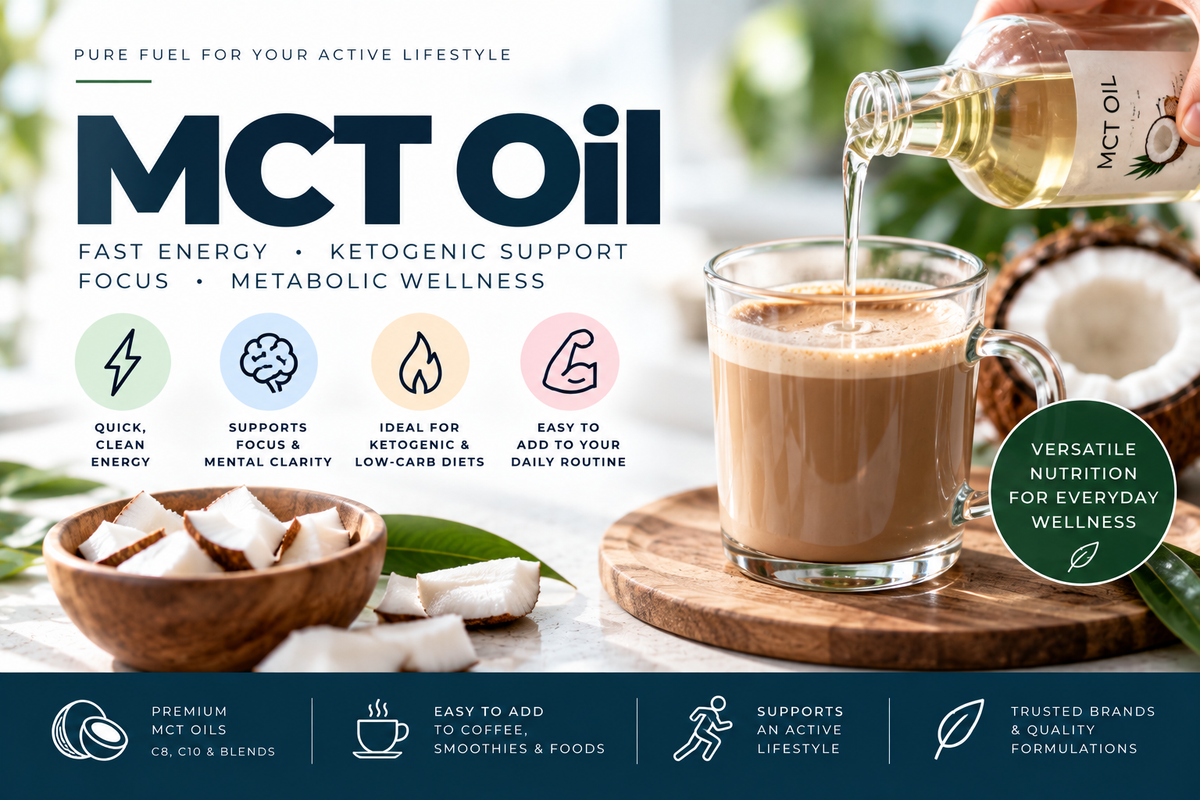
MCT Oil – Fast Energy, Ketogenic & Metabolic Support
Explore MCT oils and medium-chain triglyceride supplements designed to provide a rapidly available source of dietary fat for energy, ketogenic nutrition, active lifestyles, and convenient everyday use.
────────────────────────────────────
About MCT Oil
MCT oil is a concentrated source of medium-chain triglycerides (MCTs)—dietary fats that are metabolized differently from most long-chain fats found in food.
Compared with long-chain triglycerides, MCTs are absorbed relatively rapidly and transported to the liver, where their fatty acids can be used as an energy source or converted into ketone bodies, particularly when carbohydrate availability is low.
The MCT Oil collection at Coal Harbour Pharmacy includes liquid oils, powders, softgels, and specialty formulations featuring different combinations of medium-chain fatty acids, including caprylic acid (C8) and capric acid (C10).
MCT oil is particularly popular with people following ketogenic or lower-carbohydrate diets, athletes looking for a convenient source of dietary energy, and anyone wanting an easy-to-use fat that can be added to beverages and foods.
Key Benefits
• Provides a concentrated source of medium-chain triglycerides
• Rapidly absorbed and metabolized compared with many long-chain fats
• Can increase production of ketone bodies
• Convenient for ketogenic and lower-carbohydrate nutrition
• Provides approximately 8–9 calories per gram as dietary fat
• Easy to incorporate into beverages, smoothies, and foods
• Available as liquid oils, powders, capsules, and targeted C8/C10 formulations
Who It’s Ideal For
MCT products may appeal to:
• People following ketogenic or lower-carbohydrate diets
• Individuals looking for a convenient source of dietary fat
• Active adults incorporating MCTs into sports-nutrition routines
• People interested in nutritional ketosis
• Customers looking for C8- or C10-focused MCT products
• Individuals who prefer adding supplemental fats to smoothies, shakes, or coffee
• People comparing MCT oil with coconut oil
MCT oil is a dietary fat—not a stimulant, essential nutrient, or guaranteed weight-loss supplement.
What Are Medium-Chain Triglycerides?
Triglycerides consist of a glycerol backbone attached to three fatty acids.
MCTs contain medium-chain fatty acids, which are shorter than the long-chain fatty acids that make up most dietary fats.
Commercial MCT oils commonly contain:
• Caprylic acid (C8)
• Capric acid (C10)
Some products may also contain varying amounts of:
• Caproic acid (C6)
• Lauric acid (C12)
MCT oils are commonly produced from coconut or palm-kernel-derived fats, although sourcing varies by manufacturer.
How MCT Oil Is Metabolized
One of the main characteristics of MCTs is their relatively rapid digestion and metabolism.
Compared with long-chain fatty acids, medium-chain fatty acids are more readily absorbed and transported toward the liver.
There, they can undergo oxidation for energy and, depending on metabolic conditions, contribute to the production of ketone bodies.
This distinctive metabolism is the primary reason MCTs are used in ketogenic nutrition.
MCT Oil & Ketone Production
The liver can convert MCT-derived fatty acids into ketones such as beta-hydroxybutyrate and acetoacetate.
C8 is particularly ketogenic compared with longer-chain fatty acids.
However, taking MCT oil and following a ketogenic diet are not the same thing.
MCT oil can temporarily increase ketone production even when a person’s overall diet is not strictly ketogenic, but nutritional ketosis depends on the broader dietary and metabolic context.
C8 vs C10 MCT Oil
Different MCT formulations can contain different proportions of C8 and C10.
|
Feature |
C8 – Caprylic Acid |
C10 – Capric Acid |
|---|---|---|
|
Chain length |
8 carbons |
10 carbons |
|
Absorption |
Rapid |
Rapid |
|
Ketone production |
Generally greater |
Ketogenic, but generally less than C8 |
|
Common use |
Ketone-focused products |
General MCT and energy formulations |
|
Availability |
Often sold alone or in blends |
Commonly combined with C8 |
A pure C8 product may be preferable when maximizing ketone production is the primary goal, while a C8/C10 blend can provide a practical general-purpose MCT oil.
MCT Oil vs Coconut Oil
MCT oil and coconut oil are not the same product.
Coconut oil contains a mixture of fatty acids, including substantial amounts of lauric acid (C12), along with smaller proportions of C8 and C10.
MCT oil is processed to concentrate particular medium-chain fatty acids.
|
Feature |
MCT Oil |
Coconut Oil |
|---|---|---|
|
Composition |
Concentrated selected MCTs |
Natural mixture of fatty acids |
|
Common major MCTs |
C8 and C10 |
Predominantly C12 among its medium-chain-range fatty acids |
|
Ketone production |
Generally more efficient |
Less concentrated ketogenic effect |
|
Flavour |
Often neutral |
May have coconut flavour |
|
Cooking |
Depends on product |
Common culinary oil |
|
Typical use |
Supplementation and ketogenic nutrition |
Cooking and general dietary fat |
Neither is inherently “better”; they serve different nutritional and culinary purposes.
MCT Oil & Energy
Because MCTs are relatively rapidly absorbed and metabolized, they are frequently marketed as a source of quick dietary energy.
This does not mean MCT oil produces the same effect as caffeine or another stimulant.
It provides calories from fat that can be metabolized for energy.
People following carbohydrate-restricted diets may find this characteristic particularly useful because MCTs can contribute to ketone production.
MCT Oil & Exercise
MCT oil is sometimes included in sports-nutrition routines because of its rapid metabolism.
However, current evidence does not establish MCT oil as a reliable way to:
• Increase strength
• Build muscle
• Dramatically improve endurance
• Replace carbohydrate during high-intensity exercise
Athletic performance depends on training, overall energy intake, carbohydrate availability when appropriate, protein intake, hydration, sleep, and numerous other factors.
MCT oil can contribute dietary energy, but it should not be positioned as a proven performance enhancer.
MCT Oil & Weight Management
MCTs have been investigated for potential effects on satiety, energy expenditure, and body composition.
Some research suggests replacing certain long-chain fats with MCTs may produce modest differences in energy balance or body weight in some settings.
However, MCT oil is calorie-dense dietary fat.
Simply adding substantial amounts of MCT oil to an existing diet without accounting for those calories does not guarantee weight loss and could increase total calorie intake.
It is more accurate to position MCT oil as a dietary tool that may fit certain nutrition strategies—not as a “fat burner.”
MCT Oil & Brain Energy
Ketones can serve as an alternative energy substrate for the brain.
Because MCT consumption can increase circulating ketones, researchers have investigated MCTs in several areas of cognitive and neurological health.
This is an active field of research, but general retail MCT supplements should not be represented as treatments for memory loss, dementia, Alzheimer’s disease, epilepsy, or other neurological conditions.
People using specialized ketogenic approaches for medical reasons require professional supervision.
Types of MCT Products
Liquid MCT Oil
The classic format and one of the easiest ways to adjust serving size.
It can be added to:
• Smoothies
• Protein shakes
• Coffee or tea
• Salad dressings
• Selected foods
MCT Powder
MCT oil can be converted into a powdered format using carrier ingredients.
Powders may mix more conveniently into beverages and can have a creamier texture.
Check the label because carrier ingredients vary considerably between products.
MCT Softgels
Provide pre-measured amounts in a portable format, although multiple capsules may be required to provide the same quantity found in a tablespoon of liquid oil.
C8 MCT Oil
Concentrated caprylic acid products are particularly popular among people seeking greater ketone production.
C8/C10 Blends
Provide a combination of caprylic and capric acids and are common general-purpose MCT formulations.
How to Use MCT Oil
MCT oil can be incorporated into foods and beverages according to the product directions.
Common uses include:
• Adding it to smoothies
• Blending it into coffee
• Mixing it into protein shakes
• Adding it to salad dressings
• Incorporating it into ketogenic meals
• Using it as directed in nutritional programs
MCT oil is not necessarily suitable for every high-temperature cooking application. Follow the individual manufacturer’s heating and cooking recommendations.
Start Gradually
One of the most important considerations with MCT oil is gastrointestinal tolerance.
Taking too much—particularly when first starting—can cause:
• Diarrhea
• Abdominal cramping
• Bloating
• Nausea
• Gastrointestinal urgency
Starting with a smaller amount and gradually increasing according to product directions can improve tolerance.
There is no benefit to forcing a large serving if a smaller amount is better tolerated.
MCT Oil in a Ketogenic Diet
MCT oil can be incorporated into ketogenic nutrition because it can increase ketone production.
However, a well-formulated ketogenic diet involves much more than adding MCT oil.
Overall considerations include:
• Carbohydrate intake
• Adequate protein
• Total calorie intake
• Essential fatty acids
• Vitamins and minerals
• Fibre
• Hydration
• Electrolytes
MCT oil should therefore complement—not define—the overall nutritional pattern.
Choosing an MCT Oil
For Greater Ketone Production
Consider a product emphasizing C8 caprylic acid.
For Everyday MCT Supplementation
A C8/C10 blend provides a versatile option.
For Convenient Mixing
MCT powder may work well in coffee, shakes, or travel routines.
For Portability
Softgels can be convenient, but compare the actual amount of MCT supplied per serving.
For Ingredient Simplicity
Check whether the product contains pure MCT oil or additional flavours, sweeteners, emulsifiers, or carriers.
For Source Preference
Review whether the manufacturer identifies the MCT source as coconut-derived, palm-derived, or a combination.
Safety & Responsible Use
MCT oil is generally well tolerated when used appropriately, but higher amounts commonly produce gastrointestinal effects.
People with significant liver disease, digestive disorders, fat-malabsorption conditions, or complex metabolic conditions should discuss substantial MCT supplementation with an appropriate healthcare professional.
People with diabetes who are using ketogenic diets or making major changes to carbohydrate intake should also consider medication and glucose-management implications with their healthcare team.
MCT oil should not be used to self-treat medical conditions requiring a therapeutic ketogenic diet.
FAQs
What is MCT oil?
MCT oil is a concentrated source of medium-chain triglycerides, usually emphasizing caprylic acid (C8), capric acid (C10), or a combination of the two.
Is MCT oil the same as coconut oil?
No. Coconut oil contains a broad mixture of fatty acids, while MCT oil is processed to concentrate selected medium-chain triglycerides.
Does MCT oil increase ketones?
Yes. MCTs can be converted into ketone bodies by the liver, with C8 generally producing a greater ketogenic response than longer-chain fatty acids.
Which is better: C8 or C10?
It depends on the goal. C8 is particularly useful when ketone production is the priority, while C8/C10 blends are common for general MCT supplementation.
Does MCT oil help with weight loss?
Research suggests MCTs may modestly influence satiety, energy expenditure, or body composition in some circumstances, but MCT oil contains substantial calories and does not independently cause weight loss.
Does MCT oil give you energy?
MCTs provide dietary energy and are metabolized relatively rapidly, but they are not stimulants like caffeine.
Can I put MCT oil in coffee?
Yes, if consistent with the product directions and your nutritional goals. Remember that adding MCT oil also adds calories.
Can MCT oil cause diarrhea?
Yes. Diarrhea, cramping, nausea, and gastrointestinal urgency are common when too much is consumed, especially when first starting.
Should I start with a full serving?
Not necessarily. Many people tolerate MCT oil better when starting with a smaller amount and gradually increasing according to the product instructions.
Do I need to follow a keto diet to use MCT oil?
No. MCT oil can be consumed outside a ketogenic diet, although it is particularly popular in low-carbohydrate and ketogenic nutrition.
Why Shop MCT Oil at Coal Harbour Pharmacy?
• Pharmacist-curated MCT oils and nutritional supplements
• C8, C10, and blended MCT options
• Liquid oils, powders, and convenient supplement formats
• Options for ketogenic and active-lifestyle nutrition
• Trusted Canadian and professional wellness brands
• Fast Canada-wide shipping
Related Collections
────────────────────────────────────
Shop MCT Oil →
Sort by
3 products




FREE STANDARD SHIPPING
Satisfied or refunded
Top-notch support
Secure payments
Encrypted checkout processing
Offers exclude prescriptions and in-store purchases.
Subscribe & Get a First-Order Reward
Plus, earning reward points on eligible online purchases and enjoy future store credit.
We respect your inbox at Coal Harbour Pharmacy - Expect thoughtfully curated health and wellness updates, timely reminders, and exclusive online savings.